
The Arab Refugees
October 2, 1948 | © The Economist

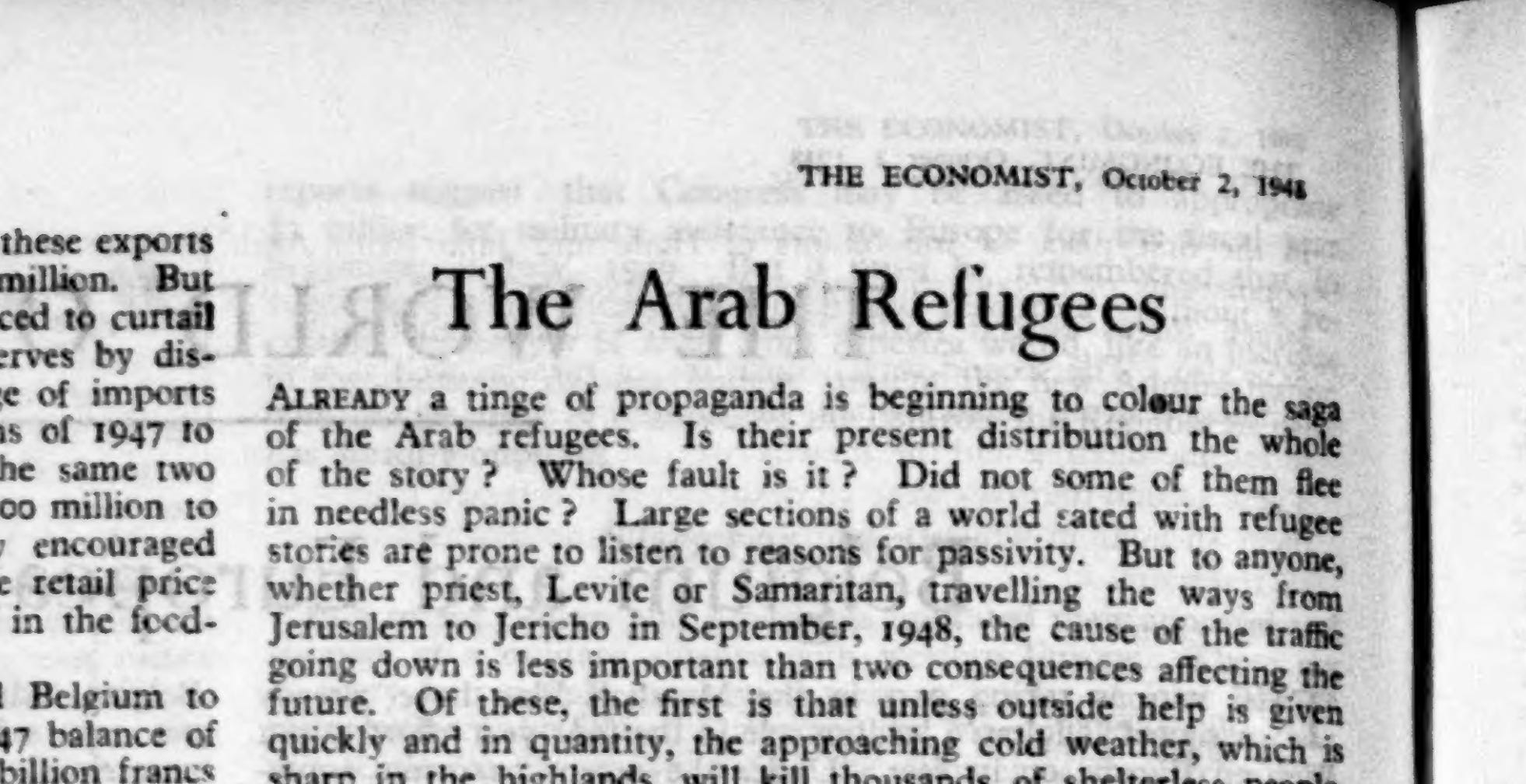
ALREADY a tinge of propaganda is beginning to colour the saga of the Arab refugees. Is their present distribution the whole of the story? Whose fault is it? Did not some of them flee in needless panic? Large sections of a world sated with refugee stories are prone to listen to reasons for passivity. But to anyone, whether priest, Levite or Samaritan, travelling the ways from Jerusalem to Jericho in September, 1948, the cause of the traffic going down is less important than two consequences affecting the future.
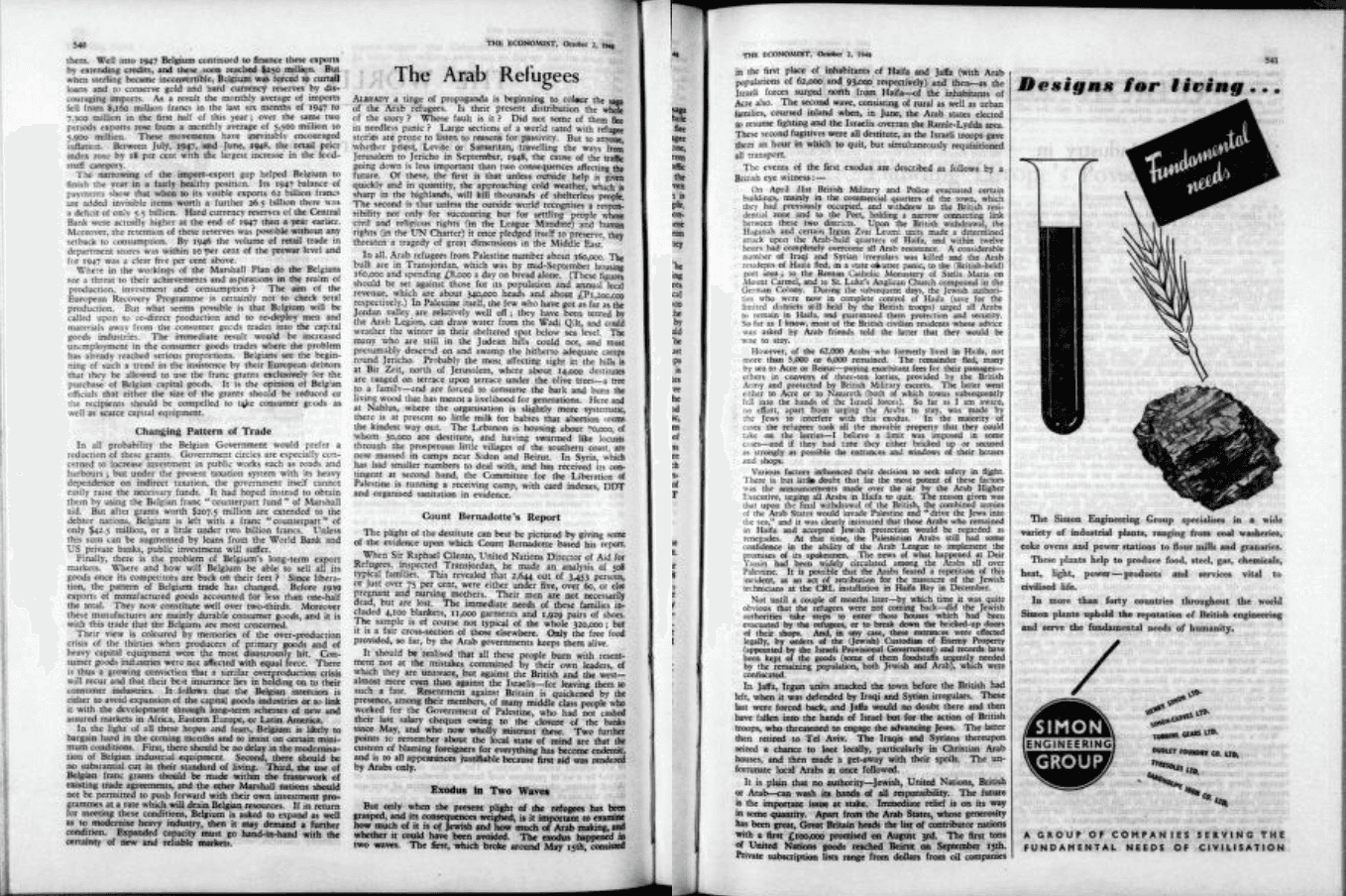
THE FULL COPYRIGHTED STORY CAN BE READ HERE: LINKIn all, Arab refugees from Palestine number about 360,000. The bulk are in Transjordan, which was by mid-September housing 160,000 and spending £8,000 a day on bread alone. (These figures should be set against those for its population and annual local revenue, which are about 340,000 heads and about £1,200,000 respectively.) In Palestine itself, the few who have got as far as the Jordan valley are relatively well off; they have been tented by the Arab Legion, can draw water from the Wadi Qilt, and could weather the winter in their sheltered spot below sea level. The many who are still in the Judean hills could not, and must presumably descend on and swamp the hitherto adequate camps round Jericho.
***
Count Bernadotte’s Report
The plight of the destitute can best be pictured by giving some of the evidence upon which Count Bernadotte based his report.
When Sir Raphael Cilento, United Nations Director of Aid for Refugees, inspected Transjordan, he made an analysis of 508 typical families. This revealed that 2,644 out of 3,453 persons, or just over 75 per cent, were either under five, over 60, or else pregnant and nursing mothers. Their men are not necessarily dead, but are lost.
***
It should be realised that all these people burn with resentment not at the mistakes committed by their own leaders, of which they are unaware, but against the British and the west-almost more even than against the Israelis-for leaving them to such a fate. Resentment against Britain is quickened by the presence, among their members, of many middle class people who worked for the Government of Palestine, who had not cashed their last salary cheques owing to the closure of the banks since May, and who now wholly mistrust these. Two further points to remember about the local state of mind are that the custom of blaming foreigners for everything has become endemic, and is to all appearances justifiable because first aid was rendered by Arabs only.
Exodus in Two Waves
***
The exodus happened in two waves. The first, which broke around May 15th, consisted in the first place of inhabitants of Haifa and Jaffa (with Arab populations of 62,000 and 93,000 respectively) and then-as the Israeli forces surged north from Haifa-of the inhabitants of Acre also. The second wave, consisting of rural as well as urban families, coursed inland when, in June, the Arab states elected to resume fighting and the Israelis overran the Ramle-Lydda area. These second fugitives were all destitute, as the Israeli troops gave them an hour in which to quit, but simultaneously requisitioned all transport.
The events of the first exodus are described as follows by a British eye witness:-
On April 21st British Military and Police evacuated certain buildings, mainly in the commercial quarters of the town, which they had previously occupied, and withdrew to the British residential zone and to the Port, holding a narrow connecting link between these two districts.
***
During the subsequent days, the Jewish authorities who were now in complete control of Haifa (save for the limited districts still held by the British troops) urged all Arabs to remain in Haifa, and guaranteed them protection and security. So far as I know, most of the British civilian residents whose advice was asked by Arab friends told the latter that they would be wise to stay.
However, of the 62,000 Arabs who formerly lived in Haifa, not more than 5,000 or 6,000 remained. The remainder fled, many by sea to Acre or Beirut-paying exorbitant fees for their passages-others in convoys of three-ton lorries, provided by the British Army and protected by British military escorts. The latter went either to Acre or to Nazareth (both of which towns subsequently fell into the hands of the Israeli forces). So far as I am aware, no effort, apart from urging the Arabs to stay, was made by the Jews to interfere with this exodus.
***
Various factors influenced their decision to seek safety in flight. There is but little doubt that far the most potent of these factors was the announcements made over the air by the Arab Higher Executive, urging all Arabs in Haifa to quit. The reason given was that upon the final withdrawal of the British, the combined armies of the Arab states would invade Palestine and “drive the Jews into the sea,” and it was clearly intimated that those Arabs who remained in Haifa and accepted Jewish protection would be regarded as renegades. At that time, the Palestinian Arabs still had some confidence in the ability of the Arab League to implement the promises of its spokesmen. The news of what happened at Deir Yassin had been widely circulated among the Arabs all over Palestine. It is possible that the Arabs feared a repetition of this incident, as an act of retribution for the massacre of the Jewish technicians at the CRL installation in Haifa Bay in December.
Not until a couple of months later-by which time it was quite obvious that the refugees were not coming back - did the Jewish authorities take steps to enter those houses which had been evacuated by the refugees, or to break down the bricked-up doors of their shops. And, in any case, these entrances were effected legally, by orders of the (Jewish) Custodian of Enemy Property (appointed by the Israeli Provisional Government) and records have been kept of the goods (some of them foodstuffs urgently needed by the remaining population, both Jewish and Arab), which were confiscated.
In Jaffa, Irgun units attacked the town before the British had left, when it was defended by Iraqi and Syrian irregulars. *** The Iraqis and Syrians thereupon seized a chance to loot locally, particularly in Christian Arab houses, and then made a get-away with their spoils. The unfortunate local Arabs at once followed.
It is plain that no authority - Jewish, United Nations, British or Arab - can wash its hands of all responsibility. The future is the important issue at stake. Immediate relief is on its way in some quantity.
***
October 2, 1948 | © The Economist
Archival material reproduced here for educational and research purposes under fair use. Original copyright belongs to the respective publisher.
Every headline has a history. We go back to the archives of the same media you read today — to show how their own words have changed. Facts don’t expire. Narratives do.